

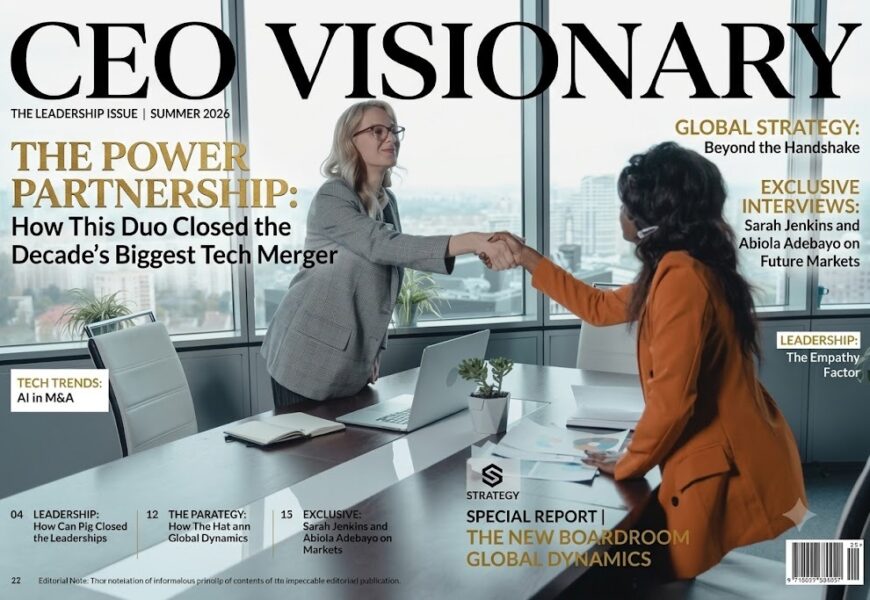
For decades, the traditional corporate boardroom operated under a relatively homogenous architecture. Governance was heavily characterized by insular networks and legacy appointments. However, a major structural shift is currently underway. Driven by institutional investor mandates, shifting regulatory landscapes, and an evolving global risk profile, the composition of international boards is transforming rapidly.
At the center of this evolution is a new cadre of elite female executives who are fundamentally shifting how global enterprise strategy is reviewed, challenged, and executed.
Leading by Example: The Vanguard of High-Finance and Technology
The transformation of global corporate governance is most visible at the absolute peak of institutional finance and market infrastructure. Rather than occupying purely advisory or non-executive positions, women are actively steering some of the most capital-intensive organizations in world history.
Consider Jane Fraser, Chief Executive Officer of Citigroup. Navigating one of the most complex corporate restructurings in modern banking history requires a governance style that values aggressive structural simplification and risk transparency over institutional inertia. Similarly, Adena Friedman, Chair and CEO of Nasdaq, has radically shifted the organization from a traditional stock exchange operator into a high-performance technology and analytics provider.
These leaders demonstrate that shifting corporate governance is not about maintaining the status quo—it is about possessing the strategic foresight to aggressively modernize institutional frameworks for international markets.
The Strategic Imperative: Beyond the Equity Metrics
While corporate social responsibility frameworks frequently champion diversity from a cultural standpoint, high-level corporate strategy demands a far more cold, performance-driven rationale. Data consistently demonstrates that diversified board oversight actively correlates with superior financial metrics and enterprise durability.
This strategic leverage operates across three primary vectors:
- Enhanced Compliance and Oversight: Boards with a broader spectrum of operational experience exhibit fewer governance failures and display greater proactive compliance with evolving cross-border regulations.
- Complex Risk Mitigation: Homogeneous groups are structurally prone to groupthink, an asset liability when analyzing multifaceted global threats like cybersecurity, geopolitical supply chain fragmentation, and currency volatility.
- Superior Multi-Market Execution: As enterprises scale across varied cultural and regulatory terrains, a board with diverse operational backgrounds provides the nuanced regional insights required for flawless market entry and localization.
Conclusion: Driving Global Enterprise Resilience
Shaking up the boardroom is no longer an optional, public-relations exercise. It is a rigorous strategic imperative designed to protect shareholder value in an increasingly volatile economic climate.
The inclusion of elite female executives within corporate governance frameworks brings a vital combination of structural discipline, strategic agility, and risk transparency. Ultimately, the modern boardroom is shifting because the nature of global business has shifted—and enterprise resilience now depends on diversified strategic oversight.